

Introduction
Wearable technology has evolved from a niche gadget category into one of the most influential areas of consumer electronics and digital healthcare. Smart wearable devices now support everyday productivity fitness communication entertainment and wellness without demanding constant interaction with smartphones or larger screens.
Modern lifestyles increasingly rely on connected ecosystems where smart wearable technology quietly handles notifications biometric tracking navigation stress monitoring and contactless payments throughout the day. A smartwatch now functions as a health dashboard. Smart rings track sleep patterns with surprising accuracy. AI powered earbuds translate conversations in real time while smart glasses introduce screen free digital interaction.
Industry reports from research organizations including IDC indicate that the global wearable technology market continues to expand rapidly due to growing interest in proactive healthcare and intelligent lifestyle monitoring. Scientific studies published in wearable technology journals also highlight the role of sensors and biometric analytics in preventive healthcare and real time wellness monitoring.
The shift toward wearable technology reflects a larger transformation in consumer behavior. Health awareness productivity optimization and connected living now influence purchasing decisions more than novelty or fashion appeal alone. Smart wearable devices increasingly serve as long term lifestyle investments rather than temporary tech accessories.
This guide explores the evolution of wearable technology categories use cases healthcare applications AI integration sensor innovation future trends and practical challenges shaping the next generation of smart wearable ecosystems.
1. What is Smart Wearable Technology
Wearable technology refers to electronic devices worn directly on the body that combine wireless connectivity computing systems sensors and software to deliver real time information and personalized insights.
Unlike traditional gadgets wearable technology remains continuously active throughout daily routines. These devices collect biometric and environmental data while synchronizing with smartphones cloud systems or AI powered applications.
Modern wearable technology commonly includes
- Smartwatches
- Fitness trackers
- Smart rings
- Smart glasses
- Smart clothing
- AI earbuds
- Medical monitoring wearables
The growing popularity of wearable technology largely comes from convenience and passive data collection. Instead of manually entering information users receive automated insights related to activity levels heart rate sleep quality recovery stress and productivity.
Research published in scientific wearable technology journals highlights how biometric sensors and machine learning algorithms continue improving wearable accuracy and predictive health monitoring capabilities. Advanced wearables now support ECG analysis oxygen saturation monitoring hydration tracking and even early illness detection through behavioral pattern recognition.
Wearable technology no longer represents futuristic experimentation. It has become part of mainstream digital infrastructure.
2. Smart Wearable
Wearables are often referred to as devices worn by individuals. “Smart Wearable” is an umbrella term for digitally connected gear that offers convenience, health insights, and lifestyle and productivity enhancements. These devices seamlessly sync with smartphone apps and cloud systems, enhancing personal wellness monitoring, activity tracking, and smart communication.
What Is Wearable Technology? A Beginner’s Guide to Smart Wearables
3. Smart Wearable In 2026
Market Size & Product Type Market Share
The global smart wearable market has witnessed remarkable growth over the past decade, with the market size reaching USD 80 billion in 2020, nearly tripling since 2014. By 2026
, it is projected to grow further to USD 138 billion, driven by the rising demand for health-focused and AI-powered wearable technologies. Devices have evolved to offer real-time physiological tracking, biometric sensors, and edge computing capabilities, enabling ultra-personalized health diagnostics and lifestyle insights. This shift toward intelligent, adaptive wearable ecosystems marks a significant milestone in the industry’s evolution.
Additionally, the wearable payments segment is also seeing explosive growth, with its market size expected to rise from USD 57.98 billion in 2024 to USD 148.88 billion by 2030, growing at a CAGR of 17.1%. Fitness trackers currently hold a dominant 41.9% share of device revenue, while smartwatches are emerging as the fastest-growing category. Regionally, North America leads in revenue, but Asia Pacific is expected to register the highest growth rate through the forecast period.
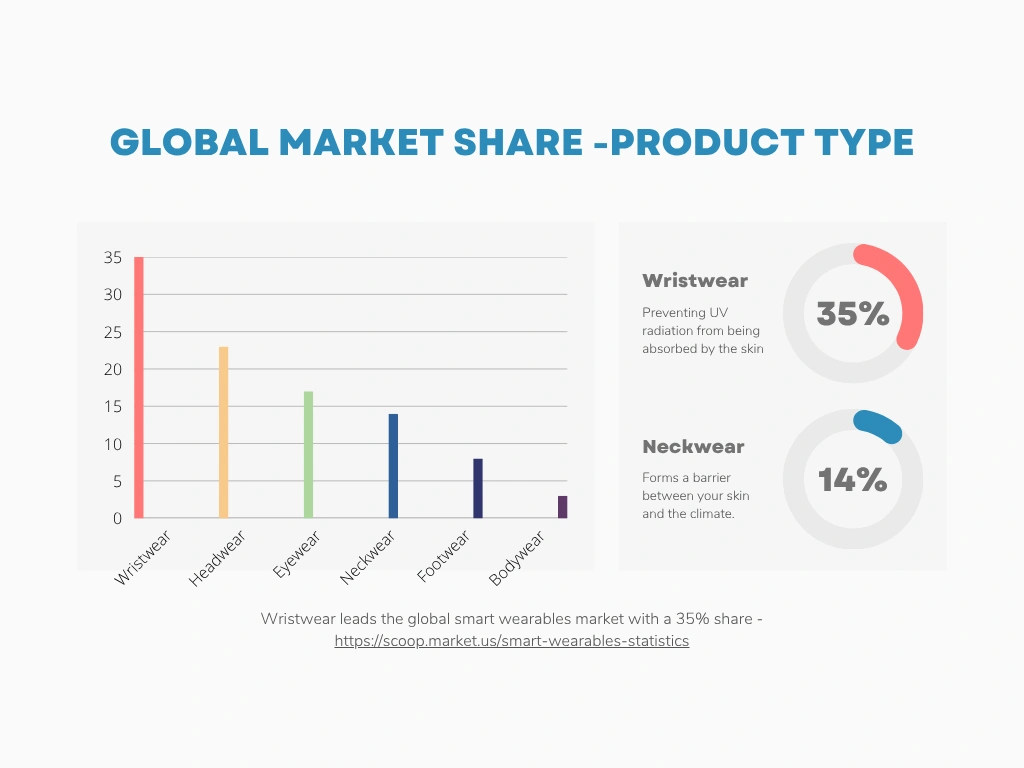
Global Market Share Product Type:
Wristwear leads the global smart wearables market with a 35% share, followed by headwear at 23% and eyewear at 17%. Neckwear contributes 14%, footwear 8%, and bodywear the smallest at 3%. This reflects strong consumer preference for wrist and head-based wearables.
Read More: Smart Ring vs Smartwatch
4. What are Smart Wearable Devices
Smart wearable devices range from fitness bands and smartwatches to smart glasses, clothing, and medical monitors. These tools empower users with real-time access to health stats, alerts, and interconnectivity with other smart systems.
Wearable Technology Terms Explained
5. Categories of Smart Wearables
Smart Wearable SmartWatch Companies
Smartwatches remain the most dominant wearable technology category due to their balance of health tracking productivity and convenience. Popular devices from brands like Apple Samsung Garmin and Fitbit support
- ECG monitoring
- Blood oxygen tracking
- GPS navigation
- Workout analytics
- Sleep analysis
- Fall detection
- Smart notifications
These features create strong affiliate potential because consumers increasingly view smartwatches as daily essentials rather than optional accessories.
Top brands like Apple, Samsung, Fitbit, and Garmin lead the market with innovations like ECG support, fall detection, and advanced fitness metrics, catering to both tech enthusiasts and health conscious users. In the modern lifestyle, these watches offer vital convenience, acting as fitness coaches, health monitors, and communication hubs from the wrist.
Fitness Wearable Technology
Fitness bands remain highly popular among users seeking affordable wearable technology focused primarily on activity tracking and wellness monitoring.
Modern fitness wearables support
- Step counting
- Calorie expenditure
- Heart rate tracking
- Recovery scoring
- Guided workouts
- Hydration reminders
Fitness focused wearable technology appeals strongly to beginner wellness audiences and budget conscious buyers exploring entry level smart wearable ecosystems.
Smart Rings
Smart rings represent one of the fastest growing wearable technology segments.
Compact ring based wearables provide
- Sleep tracking
- Recovery monitoring
- Stress analysis
- Temperature sensing
- Contactless payments
Devices like the Oura Ring gained popularity because of discreet design and reliable overnight biometric tracking.
Scientific studies suggest finger based sensors often deliver more stable biometric readings compared to wrist based positioning due to improved blood flow consistency.
Smart rings appeal strongly to users seeking minimalistic wearable technology without large displays or constant notifications.
Smart Wearable Apps
Wearable apps like Apple Health, Google Fit, Calm, and Spotify on WearOS enable users to track steps, meditation, heart health, and entertainment making wellness a central part of daily digital life. These apps fuel productivity, mindfulness, and connectivity, all essential for a balanced modern routine.
Smart Wearable Clothing
Smart clothing integrates sensors in fabrics to monitor vitals, detect posture shifts, and prevent injuries. Often used in sports and elder care, these garments merge comfort with real-time analytics. In today’s lifestyle, they provide functional fashion and tech-driven support for performance and well-being.
Smart Glasses and AR Wearables
Smart glasses introduce hands free interaction through voice commands augmented reality overlays and AI powered assistance.
Products like Ray-Ban Meta Smart Glasses combine photography messaging music streaming and contextual AI support within familiar eyewear designs.
AR wearable technology continues expanding across
- Healthcare
- Logistics
- Remote collaboration
- Navigation
- Education
- Entertainment
Enterprise adoption continues rising because smart glasses improve operational efficiency while reducing dependence on handheld screens.
Smart glasses such as Meta Ray-Ban and Vuzix offer AR overlays, voice commands, navigation, and hands-free interaction blending fashion with futuristic functionality. For busy professionals or multitaskers, these glasses offer a screen-free digital interface that keeps them connected without distraction.
Smart Clothing and E Textiles
Smart clothing integrates sensors directly into fabric materials for continuous biometric monitoring.
Applications include
- Athletic performance analysis
- Posture correction
- Rehabilitation monitoring
- Elderly care
- Temperature regulation
Scientific research surrounding e textiles focuses heavily on comfort durability washability and sensor accuracy.
Smart wearable clothing may eventually become one of the most scalable healthcare monitoring systems because users interact naturally with garments throughout daily routines.
Smart Jewellery
Smart rings and pendants like the Oura Ring and Bellabeat Leaf offer heart rate monitoring, sleep tracking, and menstrual cycle insights all housed in stylish, discreet designs. These are perfect for modern users who value subtle aesthetics and personal wellness tracking.
Smart Wearable Cameras
From GoPro to Snap Spectacles, these cameras document first-person perspectives for adventure, journalism, or law enforcement streaming or storing content via connected devices. They suit today’s lifestyle of vlogging, real-time sharing, and hands-free recording of memorable moments.
Read More: What Is a Wearable Fitness Monitor and How Do You Choose the Right One
Smart Payment Wearables
Smart payment wearables like NFC enabled rings and watches allow users to make contactless payments securely and effortlessly, replacing wallets in favor of tap and go convenience. In a fast paced world, these wearables offer unmatched speed and hygiene in financial transactions.
Augmented Reality (AR) Glasses
AR glasses are used in healthcare, logistics, and gaming to provide spatial overlays, voice integration, and real time digital assistance for hands free productivity. They enhance how we learn, interact, and perform tasks in complex, information-rich environments.
Smart Wearable Ear-Worn / Smart Earwear
AI powered earbuds evolved far beyond music playback. Modern ear worn wearable technology supports
- Real time translation
- Voice assistants
- Hearing enhancement
- Noise adaptation
- Health tracking
Devices like Google Pixel Buds Pro and advanced hearing wearables increasingly function as intelligent communication assistants.
Ear based biometric monitoring also attracts growing medical research interest due to stable temperature and pulse measurement opportunities.
Devices like Google Pixel Buds and Nuheara IQbuds combine voice assistants, biometric data tracking, and real-time language translation for an immersive, intelligent audio experience. In the modern global lifestyle, these earables break language barriers and deliver seamless smart interaction.
6. Why Wearable Technology Became Mainstream
Several major lifestyle and technology trends accelerated wearable technology adoption across global markets.
Health Focused Consumer Behavior
Preventive healthcare has become a major consumer priority. Smart wearable devices help users monitor physical activity cardiovascular performance sleep consistency and stress levels before symptoms become severe.
Fitness trackers and smartwatches encourage healthier habits through visual progress tracking movement reminders and wellness scoring systems.
Smartphone Ecosystem Integration
Modern wearable technology works seamlessly alongside smartphones tablets smart home systems and cloud services. Notifications navigation communication and entertainment now extend naturally to wearable screens and voice interfaces.
AI Powered Personalization
Artificial intelligence transformed wearable technology from passive tracking into intelligent digital assistance. Smart wearables now interpret biometric trends generate personalized recommendations and identify behavioral patterns over time.
Remote Work and Digital Mobility
Flexible work environments increased demand for lightweight connected technology. Smart wearable devices help professionals remain connected without constant smartphone interaction during commuting meetings workouts or travel.
Scientific Advancement in Sensors
Sensor miniaturization enabled powerful biometric tracking within compact wearable designs. Academic studies continue improving sensor reliability accuracy and energy efficiency for healthcare applications.
IDC market analysis projects substantial wearable technology growth through the next decade as healthcare fitness and AI ecosystems continue converging.
7. Components of Smart Wearable
Smart wearables are intricate devices composed of several advanced components that work together to monitor health, enhance user interaction, and deliver personalized experiences. Below are the key components:
- Sensors: These are the core of smart wearables, enabling them to collect real-time data. Common types include:
- PPG sensors for heart rate monitoring
- Accelerometers and gyroscopes for tracking motion
- Sweat and temperature sensors for hydration and thermal analysis
- GPS modules for location tracking and movement analysis
- PPG sensors for heart rate monitoring
- Power Unit: Wearables operate using various power sources, including rechargeable or disposable batteries and energy-harvesting technologies, ensuring continuous usage even in compact devices.
- Processing & Control Units: These onboard microprocessors handle essential tasks such as data filtering, real-time calculations, and even AI-based analytics, ensuring that the data collected is meaningful and actionable.
- Embedded Storage: Some devices include flash-type storage media to locally store user data before syncing it to the cloud or smartphone apps for deeper analysis.
- Network Interfaces: Smart wearables use Bluetooth, Wi-Fi, or other wireless protocols to communicate with smartphones, create personal area networks (PANs), or directly transmit data to cloud servers.
- Actuators: These components offer feedback to users through vibration, lights, sound, or visual displays, and in some advanced health applications, may also include automated actions like defibrillation or medication delivery.
Together, these components enable smart wearables to offer seamless, real-time health monitoring and user interaction, forming the backbone of modern digital wellness ecosystems.
8. Key Sensor Types in Smart Wearables
Smart wearables integrate a variety of sensors to track user health, environmental conditions, and enable interactive features. These sensors fall into human-centric, environmental, or dual-purpose categories. Here’s a list of the most important types:
- Smart Fabrics: E-textiles embedded with conductive threads or electronics, used in wearables like yoga pants and compression shirts for fitness tracking.
- ECG Sensors: Measure heart’s electrical activity for cardiac health; found in chest monitors and smartwatches like Apple Watch Series 6.
- NFC: Allows short-range communication used in payments, authentication, and proximity detection; integrated into smart rings and watches.
- GSR Sensors: Measure skin conductivity to detect stress or emotional responses; used in wristbands like Empatica E4.
- PPG Sensors: Use light absorption to track blood volume changes, heart rate, and oxygen levels; common in fitness bands and smartwatches.
- EEG Sensors: Monitor brainwave activity for neurological diagnostics or brain-computer interface control; used in headsets like Emotiv EpocX.
- Glucose Monitors: Track blood sugar levels continuously or at intervals; essential for diabetic care (e.g., Dexcom G6 CGM).
- Infrared Sensors: Detect body or ambient temperature; used in fertility and ovulation trackers.
- Accelerometers/Gyroscopes: Detect motion and orientation; widely used in activity trackers, smartwatches, and smartphones.
- Microphones: Capture sound for activity detection or health analysis; used in smart stethoscopes and ambient recognition tools.
- Location Sensors: Include GPS and other systems to track positioning; critical in wearables for sports, safety, and child/pet tracking.
- CMOS/CCD Imaging Sensors: Capture images for applications like facial recognition, object detection, and AR; used in smart glasses and body cameras.
- RFID Tags: Store and transmit user identity or asset info; used for tracking and authentication purposes.
- Laser Emitters: Measure distance via LiDAR or deliver therapeutic functions; found in AR glasses and pain management belts.
- Ultrasound Sensors: Detect nearby objects or serve imaging functions in medical devices like smart canes or handheld ultrasounds.
- Air Quality Sensors: Monitor harmful gases or particulates; found in portable environmental monitoring devices.
- Spectrometers: Analyze light to determine material composition; useful in food, cosmetics, or health applications.
- Radiation Sensors: Detect radiation exposure; vital for occupational health and safety in specific environments.
- Barometric Pressure Sensors: Track altitude and detect atmospheric pressure changes; used in adventure and fitness wearables.
- Compass: Determines direction/orientation for navigation; a basic yet essential feature in most smartwatches.
These sensors empower wearables to be multi-functional, catering to fitness, healthcare, environmental awareness, navigation, and real-time feedback needs.
2026 Smartwatch Guide: Which Model Fits Your Lifestyle?
9. Smart Wearable Use Cases & Applications
Health Monitoring
Healthcare remains the strongest wearable technology application. Modern smart wearable devices track
- Heart rate
- Blood oxygen
- Blood pressure trends
- Sleep quality
- Stress levels
- Respiratory patterns
Research published in digital healthcare journals suggests wearable technology may improve preventive healthcare outcomes through continuous monitoring and earlier anomaly detection.
Wearable technology increasingly supports chronic condition management for cardiovascular disease diabetes and respiratory disorders.
These devices track metrics such as heart rate, calorie burn, step count, sleep quality, and stress using PPG, HRV, and accelerometer data. The insights help users understand their physical health and adopt healthier lifestyles.
Fitness Optimization
Fitness wearable technology helps users understand workout intensity recovery and physical performance trends.
AI powered analytics provide
- Recovery recommendations
- Personalized training guidance
- VO2 max estimation
- Fatigue monitoring
- Exercise consistency tracking
Gamification also improves user motivation through achievement systems progress rings and social competition.
Chronic Condition Management
Wearables detect early signs of health issues like cardiovascular stress or neurological disorders using data trends. By alerting users in real-time, they facilitate early intervention and continuous condition management.
Lifestyle Integration
Smart wearables go beyond fitness, they support message notifications, app alerts, music control, and daily scheduling, offering convenience and digital assistance while promoting a healthier lifestyle.
Mental Wellness Tracking
Stress management features became increasingly important across wearable technology platforms. Wearables analyze
- Heart rate variability
- Sleep irregularities
- Breathing patterns
- Activity changes
Many smart wearable apps now recommend mindfulness breathing exercises or relaxation sessions based on biometric indicators.
Mental wellness integration significantly expands wearable technology beyond simple fitness tracking.
Analyzing biometric data like heart rate variability and sleep patterns, wearables can detect stress levels and suggest relaxation techniques. This supports better emotional regulation and mental wellness.
Contactless Payments
Payment enabled wearable technology supports faster transactions through NFC integration.
Smart rings watches and wristbands simplify retail purchases while reducing dependency on physical wallets or smartphones.
The wearable payment market continues expanding rapidly due to convenience and consumer preference for touch free transactions.
Productivity and Communication
Wearable technology improves digital accessibility throughout busy routines. Smart wearable devices help users
- Manage notifications
- Answer calls
- Control music
- Navigate directions
- Access reminders
- Use voice assistants
10. Market Landscape & Enterprise Use
Consumer Health Market
As fitness and fashion converge, wearables are increasingly seen as essential health tools. They empower individuals to monitor wellness proactively, driving widespread adoption across demographics.
Enterprise Applications
Organizations use wearables for employee health monitoring, productivity tracking, and workplace safety. Industries like military, healthcare, and sports benefit from real-time biometric feedback and alert systems.
11. Smart Wearables in Healthcare
Healthcare represents one of the most transformative sectors for wearable technology innovation. Scientific research increasingly supports wearable integration into clinical monitoring remote patient management and preventive medicine systems.
Smart Wearable Thermometer
Continuous temperature monitoring wearables gained attention during global infectious disease outbreaks. These devices provide
- Fever alerts
- Child monitoring
- Remote caregiver tracking
- Real time temperature trends
Healthcare wearable technology reduces dependency on manual periodic measurement.
These allow continuous temperature monitoring, aiding early fever detection in children and during infectious outbreaks, providing timely alerts and easing caregiver workload. They support a proactive approach to health in daily routines, especially for families.
Blood Pressure Monitoring Wearables
Cuffless blood pressure wearable technology uses pulse transit analysis and AI algorithms to estimate cardiovascular trends. Although not full replacements for clinical devices these systems support proactive monitoring and long term health awareness.
Cuffless wearables use Pulse Transit Time (PTT) to monitor blood pressure trends throughout the day, supporting proactive heart health management without bulky equipment. For busy individuals, it offers medical insights with comfort and discretion.
Smart Wearable Breast Pump
Wearable breast pumps from brands like Elvie introduced mobility and discretion into nursing support technology. Hands free systems align strongly with modern multitasking lifestyles and mobile work environments.
Smart Wearables for Health Monitoring
These wearables track vital metrics such as ECG, glucose levels, oxygen saturation, and sleep apnea—alerting users to anomalies and promoting early medical intervention. They empower users to stay in control of their health with minimal disruption.
Smart Wearable: Your Daily Health Companion
Wearables are your 24/7 wellness partner—tracking hydration, stress, steps, and sleep. They encourage consistency in self-care with friendly nudges and goal-based motivation. This aligns with modern routines focused on proactive, tech-assisted health.
Smart Wearables for Heart Rate Monitoring
Optical sensors using PPG monitor heart rate, SpO2, and VO2 Max. These tools are essential during workouts, helping athletes and everyday users optimize performance and recovery. In the active modern lifestyle, they provide real-time insight and performance safety.
Glucose Monitoring Wearables
Continuous glucose monitors transformed diabetic care by providing real time glucose insights without repeated finger pricks. Devices like Dexcom G7 illustrate how wearable technology improves disease management convenience and quality of life.
12. What all Health Parameters does Smart Wearable track ?
Every smart wearable equipped with wearable sensors can typically monitor
- Blood Pressure
- Heart Rate
- Calorie Expenditure
- Step Counting
- Body Temperature
- Pulse Rate
- Oxygen Level
Such health monitoring wearables redefine the boundary between medical-grade equipment and consumer tech.

13. Key Challenges & Barriers
Wearable Technologies has penetrated to our daily lifestyle to an extent that its role complementing our healthy management cannot be neglected. Studies is being carried out to analyse and minimise the extent of side effects of wearable technologies. Although side effects of wearable is yet to be documented and discussed in detail on technological front, however certain aspects at the outset can be attributed to both behavioural or technical.
Health Anxiety
Continuous biometric monitoring may increase unnecessary stress among some users. Minor fluctuations in health metrics sometimes trigger over interpretation without medical context. Healthcare professionals recommend combining wearable insights with clinical guidance rather than relying exclusively on wearable data.

Data Accuracy
Wearable sensor accuracy varies depending on
- Device placement
- Movement
- Skin conditions
- Environmental interference
Scientific studies indicate ankle and finger based sensors may provide better consistency than wrist based alternatives for certain metrics.
Here’s the list of Mean Absolute Percentage Error Level based on the placement of Sensor on Human Body as per the American Journal of Public Health and studies reported in the New York Times
| Device | MAPE (Mean Absolute Percentage Error) |
| Ankle and Thigh | 1% |
| Waist | 3% |
| Wrist | 15% |
| Overall (normal speeds) | 7% |
| Overall (slow speeds) | 40% |
Source:https://ijbnpa.biomedcentral.com/articles/10.1186/s12966-022-01350-9
Following table elaborates the kind of error you can expect from the fitness tracker / Smart watches.
| Problem | What Happens |
| Heart rate errors | Fitness trackers often guess heart rate too low. |
| Calorie tracking mistakes | They usually underestimate how many calories you burn. |
| Accuracy issues | Things like exercise type, wrist position, and skin can affect results. |
| Step count errors | They miss about 9% of steps on average. |
| Sleep tracking mistakes | They overestimate sleep time by 10% and miss wake times. |
| Aerobic capacity errors | They overestimate VO2max by 15% at rest and 10% during exercise. |
Electromagnetic Field (EMF) Exposure To Human Body
These smart wearable devices generally follow standard prescribed EMF threshold values, however, consistent exposure or over exposure of human body to EMF can lead to severe pain, nausea. Today’s modern lifestyle has left human body to tremendous exposure to EMF. EMF energy arriving at the human skin is dominated by the distance between the EMF emitting device and the skin. Consistent exposure to electromagnetic fields (EMF) from wearables can, in rare cases, cause discomfort, though most devices conform to safe EMF levels. Though within safety limits, some users report symptoms like dizziness. Continued research is needed for long-term impact evaluation.
Most wearable devices operate within accepted safety standards for electromagnetic exposure. However ongoing scientific research continues evaluating long term exposure effects as wearable technology becomes increasingly integrated into daily life.
Read More: Ultimate Fitness Trackers With Automatic Workout Detection & Recovery Analytics
Data Privacy
Wearable technology collects highly sensitive biometric information. Privacy concerns remain significant because cloud based ecosystems store health related behavioral data continuously. Future regulations will likely strengthen data protection standards for wearable platforms.
Battery Limitations
Battery life continues limiting wearable technology design flexibility. Advanced sensors and bright displays increase energy demands while users still expect multi day performance. Battery innovation remains essential for long term wearable adoption.
14. Emerging Wearable Technology Trends
Smart Fabrics
Smart textiles embed electronic systems directly into garments for continuous passive monitoring. Applications include
- Occupational safety
- Sports analytics
- Rehabilitation support
- Elderly monitoring
Wearables are moving into clothing for seamless and non-intrusive health monitoring. Ideal for seniors and athletes, smart textiles track vitals continuously with minimal user effort.
Gamification & VR Fitness
Integrating wearables with VR promotes physical activity through immersive gamified experiences. This motivates users to stay consistent with fitness goals while enjoying the process.
XR and Mixed Reality
Extended reality wearable technology blends physical and digital environments. Future AR glasses may eventually replace certain smartphone functions through gesture control and contextual overlays.
Real-Time AI & Predictive Analytics
Embedded AI enables real-time health analysis and alerts, even offline. Predictive models help identify risks and recommend interventions before issues escalate.
Epidermal Electronics
Ultra thin wearable sensors attach directly to skin surfaces for highly accurate physiological monitoring. Medical researchers continue exploring epidermal technology for long term diagnostic applications.
Real Time Predictive Healthcare
AI powered wearable systems increasingly shift healthcare toward predictive intervention instead of reactive treatment. Research institutions continue studying how wearable data may identify early warning signs for illness before traditional symptoms appear.
15. AI and the Future of Wearable Technology
Artificial intelligence increasingly defines the next generation of smart wearable ecosystems. AI powered wearable technology now delivers
- Predictive analytics
- Personalized wellness insights
- Behavioral trend analysis
- Adaptive recommendations
- Real time anomaly detection
Future wearable technology may integrate genomics environmental monitoring and advanced biometric analysis for hyper personalized healthcare systems.
Read More: Future of AR Wearables: Smart Glasses, Mixed Reality & the Amazing Next Tech Revolution
Conclusion
Wearable technology transformed from simple step counters into sophisticated ecosystems supporting healthcare productivity communication wellness and digital convenience.
Smart wearable devices now influence how people monitor health manage stress improve fitness and interact with connected environments. Scientific research and industry investment continue accelerating innovation across smartwatches smart rings AI earbuds smart clothing and healthcare wearables.
The growing demand for preventive healthcare and personalized wellness strongly supports the future expansion of wearable technology markets. Real time biometric monitoring predictive analytics and AI powered insights increasingly position wearable devices as essential lifestyle infrastructure rather than optional consumer electronics.
Despite challenges related to privacy battery life and sensor accuracy wearable technology continues evolving rapidly through advances in AI sensor engineering and healthcare integration.
From smart rings quietly tracking sleep quality to AI glasses redefining hands free computing wearable technology represents one of the most practical and influential categories shaping the future of connected living.
Frequently Asked Questions
1. What is wearable technology?
Wearable technology refers to smart electronic devices worn on the body that collect data provide connectivity and deliver real time insights related to health fitness communication or productivity.
2. Are smart wearable devices accurate?
Accuracy depends on sensor quality device placement movement and user physiology. Finger based and ankle based sensors often provide stronger consistency for certain health metrics.
3. What are the benefits of using smart wearables?
Smart wearables help track fitness goals, monitor vital signs, manage stress, improve sleep, and even enable contactless payments all while keeping users connected via notifications and reminders.
4. Which smart wearable is best for fitness tracking?
Fitness trackers like Fitbit Charge, Garmin Vivosmart, and Apple Watch Series are popular for tracking heart rate, steps, sleep, and workouts, offering accurate insights for both casual and serious fitness enthusiasts.
5. Are smart wearable devices safe for everyday use?
Most wearable technology products follow established safety standards for wireless communication and electromagnetic exposure. Users should still review privacy policies and follow manufacturer guidelines for long term use.
6. Can wearable technology replace medical devices?
Wearable technology supports wellness tracking and preventive monitoring but should not fully replace certified medical equipment or professional healthcare advice.
7. Which wearable technology device is best for health tracking?
Smartwatches smart rings and fitness trackers remain the most popular wearable technology devices for monitoring heart rate sleep activity recovery and stress levels.
8. Why is wearable technology growing rapidly?
Growing health awareness AI integration smartphone connectivity and demand for preventive healthcare continue driving wearable technology adoption worldwide.
Check Out:
Best Wearable Fitness Tracker Under $200 in 2025: Expert Reviews & Money-Saving Guide

[…] For a deeper look at how wearables are evolving, see Smart Wearables Future Tech. […]
[…] demand for these wearables keeps rising every year. According to market research the global fitness tracker industry was worth […]
[…] Read More Smart Wearables Future Tech […]
[…] Smart Wearables Future Tech […]
[…] Read More: Smart Wearable for the Future ? Wear It to Believe It […]
[…] Read More: Smart Wearable for the Future ? Wear It to Believe It […]
[…] Read More: Smart Wearable for the Future ? Wear It to Believe It […]
[…] Read More:Smart Wearable for the Future […]
[…] Read More: Smart Wearable for the Future […]
[…] Read More: Smart Wearable for the Future ? Wear It to Believe It […]